Academy / Getting started
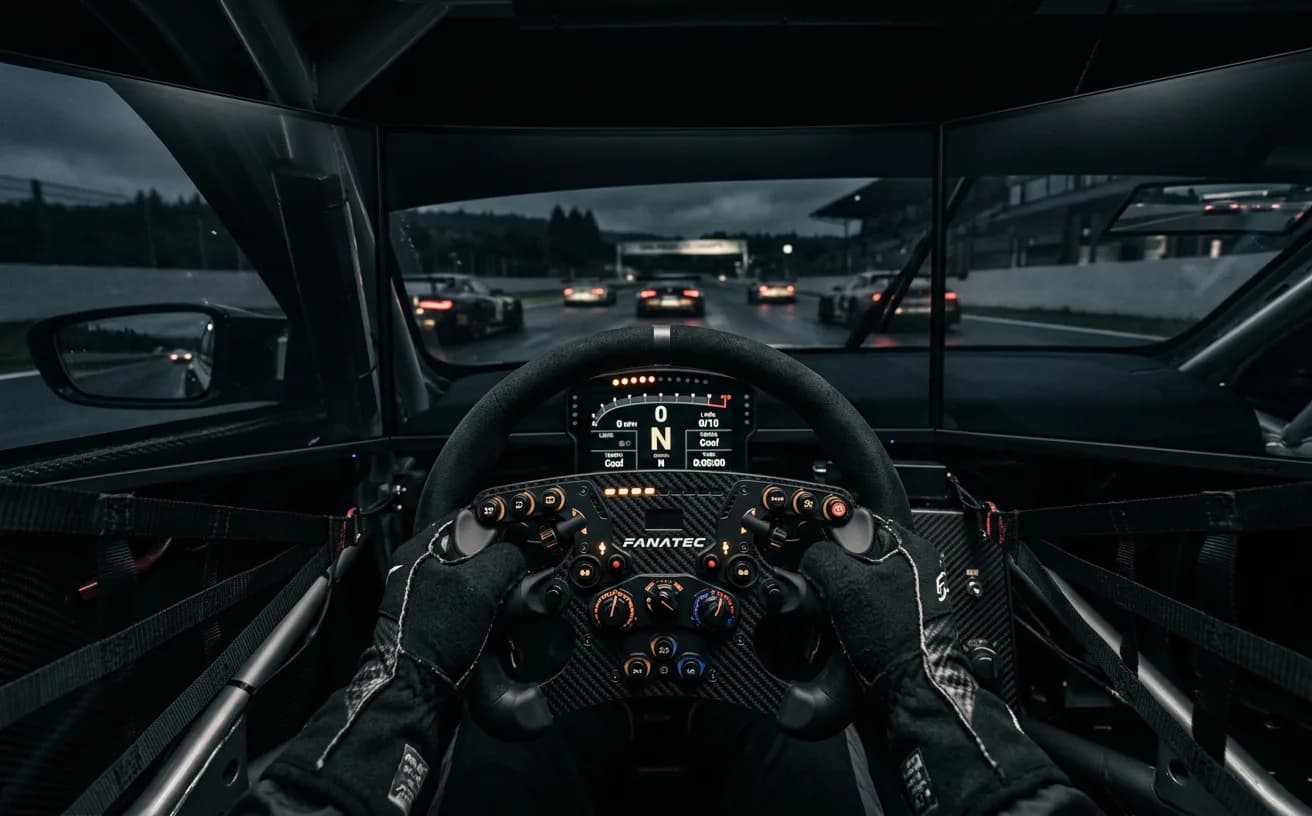
iRacing isn't a video game. It's the closest you'll get to real racing without leaving home. And that's exactly what hooks some people and scares off others.
What iRacing Is in 60 Seconds
iRacing is a subscription-based online racing simulator, widely considered the most realistic and competitive on the market. It's not arcade: the physics, the tires, the wear, and the car's behavior replicate reality with a level of detail no other game reaches.
Three things that set it apart from any other racing game:
- It's online and structured. No bots. You race against real people in official races with fixed schedules, organized into seasons like a real championship.
- It treats you like a real driver. You have a license you climb from Rookie to Pro, and two metrics that follow you everywhere: Safety Rating (how clean you are) and iRating (your skill level).
- It has consequences. Every race counts. Drive badly and you're penalized; drive well and you get promoted. There's no "restart game".
If you take just this with you, you've got the idea. Now let's get practical: what you need to start and what it's going to cost you.
How to Get Started: What You Need and What It Costs
You don't need the best gear to start. You need to start.
It's the most common rookie mistake: thinking you can't compete until you own an 800€ wheel and a cockpit. False. Thousands of drivers started with an entry-level wheel, and honestly that's the recommended path (to find out whether sim racing is really for you). Gear improves the experience and the immersion, but it's not what makes you a better driver. What makes you better is putting in laps, making mistakes, and learning. Start with what you have and upgrade your setup once you know this is for you.
What you need (hardware)
The bare minimum:
- A Windows PC that can run the game. iRacing isn't especially demanding compared to modern AAA games, but it needs a decent graphics card to run smoothly.
- A wheel + pedals. You can play with a controller to try it out, but it's not recommended: the real experience and fine control come with a wheel and pedals.
Wheel options by tier:
| Tier | Typical models | Approx. price |
|---|---|---|
| Entry | Logitech G29 / G923, Thrustmaster T248 | 200-300€ |
| Mid (Direct Drive) | Moza R5, Fanatec CSL DD | 400-600€ |
| High-end | Moza, Fanatec, Simagic, Simucube top range | 800€+ |
Something worth understanding from the start: in the mid and high-end range, what we call a "wheel" is actually two separate pieces. The base is the motor: the part that generates the force you feel in your hands (the so-called Force Feedback) and that mounts to your desk or cockpit. The rim is the part you grip, and it's interchangeable: you can fit a Formula one, a GT one, a rally one... In the entry range, by contrast, it all comes as a single integrated piece that neither separates nor lets you swap the rim.
To start, an entry-level wheel is plenty. The jump in quality from controller to entry-level wheel is huge; from entry-level to premium it's a matter of nuance.
The secret almost nobody tells you when starting out: pedals matter more than the wheel.
If you have to choose where to invest, invest in the pedals. Between a pro wheel with basic pedals and pro pedals with a normal wheel, go for the latter without hesitation. Good pedals —especially a load cell brake— genuinely lower your lap time, because braking is where a lap is won or lost. An expensive wheel improves feel and immersion, but it doesn't make you faster.
How much it costs
Before the numbers, an important note: iRacing works in US dollars. All the prices you see are in USD, but at checkout the platform converts automatically to your currency.
iRacing works by subscription, not a one-time purchase. Here's what you pay:
| Plan | Price |
|---|---|
| 1 month | $13 |
| 3 months | $33 |
| 1 year | $110 |
| 2 years | $199 |
The best time to buy is Black Friday.
Every year iRacing runs its biggest discount (up to 50%) around those dates, and there's a detail few people know: the time is cumulative. If you already have 4 months on your account and buy a year on Black Friday, you don't lose those 4 months: they stack on top of the new ones. You'd end up with 16 months of subscription at the best price of the year. That's why veteran drivers plan their big renewal for November.
On top of that, new members get discounts of up to 40% on their first subscription, and active drivers earn up to $40 a year in credits just for racing, which go toward future purchases.
What about content? Here's the part that confuses everyone. Your subscription includes for free a selection of cars and tracks that's enough to race every Rookie series. You don't need to pay anything extra to get started.
When you want to move up a category, additional cars and tracks are bought once: $11.95 per car and $11.95-14.95 per track. But careful: you don't need to buy everything. If you want to be eligible for iDollars, a season only requires 8 scoring weeks, so by picking the paid tracks you'll actually use, the spend stays under control.
Realistic first-year cost: between $150 and $200 if you get hooked, spread across months. To start racing seriously, around $50 covers a Class D season.
The trick nobody tells you: the name you enter when subscribing is your name on track, and it has to be real.
Unlike other games, iRacing doesn't allow nicknames or made-up names: you use your real name, the one the rest of the drivers will see in every race, standing, and result. Far from being a limitation, it's one of iRacing's strengths. Racing under your real name makes people behave: nobody wants their name tied to dirty driving. It's one of the reasons its community is among the most serious and clean in sim racing.
Your first steps
- Create your account on iRacing (take advantage of the new member discount).
- Install the simulator and set up your wheel or controller.
- Start in the Rookie series, which are free with your subscription.
- Put in laps in practice sessions before your first official race. Learn the track without pressure.
- Run your first race without obsessing over the result. Just finish, clean.
How the System Works in Detail
Up to here, the essentials. If you want to understand the machinery under the hood, keep reading.
The license system
In iRacing you start as Rookie and climb: Rookie → Class D → C → B → A → Pro/WC. Each promotion unlocks better series, faster cars, and more serious competition. You don't move up by winning races: you move up by driving clean and participating enough.
Pro/WC is the exception. You don't reach this license by driving clean like the others: it's invitation-only, reserved for a handful of drivers per category (around 30-50). Only the best in the world get in, those who stand out in the Pro Series. If you see someone with Pro/WC next to their name, you're looking at the elite of sim racing.
The two metrics that define you
Everything in iRacing revolves around two numbers that follow you everywhere:
Safety Rating (SR): measures how clean you are on track. The fewer incidents per corner, the higher it climbs. It's what determines your license. If you want to understand it in depth, we have a complete guide to Safety Rating.
iRating (iR): measures your skill level by comparing you to your rivals. It doesn't measure pure speed, it measures how you finish against the others. We also have a complete guide to iRating.
These two metrics are the backbone of iRacing. Understanding them well is the difference between progressing with purpose or getting frustrated without knowing why.
Content: free vs paid
Your subscription includes a base of cars and tracks that covers every Rookie series. From there, you choose what to license based on the series you want to race. There are volume discounts: from 3 items bought at once, 10%; from 6, 15%; and once you pass 40 licenses, 20% off everything after that.
Is iRacing for You?
I'm going to be honest, because iRacing isn't for everyone.
It's for you if:
- You're passionate about motorsport and want the most realistic simulation out there: on that front, iRacing has no competition.
- You enjoy improving little by little, you're not after instant gratification.
- You're motivated by competing against real people in a serious environment.
- You don't mind investing over the medium/long term in a hobby that'll give you hundreds of hours.
It's not for you if:
- You're looking for a casual arcade to run races with no commitment.
- You're not willing to invest over the medium/long term in hardware and subscription.
- You get frustrated quickly and can't handle a steep learning curve.
iRacing intimidates at first: the subscription, the hardware, the ratings, the licenses. You'll probably feel like you're arriving late and there's nothing you can do about it, but nothing could be further from the truth. Just start. Don't get bogged down in technical details or spend money buying everything that comes to mind. What matters is having fun and enjoying the process, and I can tell you that what you feel in a competitive race is... unique! Shall we get started?